

That is precisely what ICARUS is – the International Cooperation for Animal Research Using Space. A global network of researchers, satellites and mini transmitters that makes the movements of animals visible in near real time. An "internet of animals". Our Animal, Nature and Species Protection Foundation supports this project because we are convinced that understanding the movements of animals can help protect species, prevent pandemics and warn people of disasters in good time.
Tiny transmitters, big impact
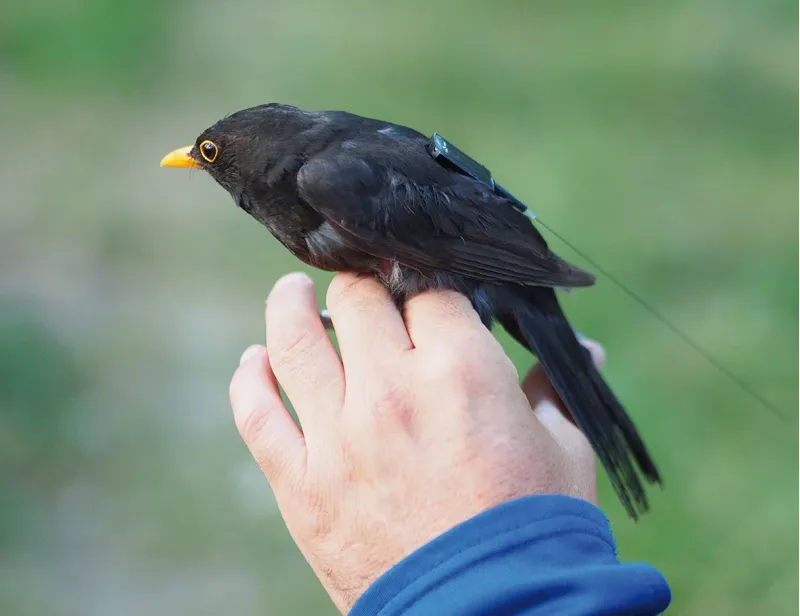
At the heart of ICARUS are high-tech transmitters, smaller than a two-pence coin and soon weighing just one gram – so light that even songbirds can carry them.
These "wearables for wild animals" determine their position via GPS or Doppler signal and measure temperature, air pressure and acceleration. They record how an animal moves – from the beating of its wings to its resting phases. When a satellite flies by, the transmitters wake up and send their data into space. From there, it flows into the Movebank database, where researchers worldwide can access it. And with the Animal Tracker app, anyone can follow the routes of "their" animals on their smartphone. Each animal observed has its own web page and email address in the Movebank Museum, recognising the individuality of animal life stories.
This creates a global picture of movement on our planet.
Animals as an early warning system
The tagged animals are more than just study subjects – they are living sensors.
Predicting natural disasters:Many animals react to the slightest changes in their environment. If they change their movement patterns before an earthquake or volcanic eruption, this can be an early warning sign. ICARUS makes such patterns visible.p>
Combating poaching:When animals are monitored globally, any unusual movement is noticed – including sudden disappearances, for example when a zebra fitted with a transmitter flees because a poacher is hunting a rhinoceros. Transparency deters poachers and increases public pressure to protect endangered species.
Preventing pandemics: Many infectious diseases – from bird flu to Ebola – originate in the animal kingdom. ICARUS shows how pathogens spread via migratory birds, wild boars and bats. Movement data makes it possible to detect disease outbreaks earlier.
Understanding climate: Animal migrations are like the Earth's ECG curves. When migratory birds avoid resting places or marine mammals change their routes, it shows where ecosystems are tipping. ICARUS provides the data to plan protected areas where they are really needed.

From the space station to the cube in space
Until spring 2022, the International Space Station (ISS) served as a receiving station, orbiting the Earth at an altitude of around 400 kilometres, close enough to pick up the weak signals from the tiny transmitters. The original ICARUS system was developed in collaboration with the Russian space agency Roscosmos.
With the war in Ukraine, all research projects with Russia were suspended. However, the Max Planck Society and the German NewSpace start-up Talos have entered into a new partnership: ICARUS 2.0.
A quantum leap in technology: the new system works with at least five CubeSats – small cubes with edges measuring ten centimetres, which are combined to form larger satellites. These cubes contain everything you need in space: power supply, control, communication – and a complete reception system for animal data.
The first satellite was launched in autumn 2025 and will begin collecting data worldwide in spring 2026. By the end of 2026, a system of six satellites could be operational. The CubeSats fly at an altitude of approximately 500 kilometres, cover the entire surface of the Earth and can read four times more transmitters simultaneously than the ISS antenna used to.
A three-metre-long antenna on a space station has thus been transformed into a handy cube in space. And this cube enables animals all over the world to tell their stories.

Flying foxes – key animals of the night
One focus of our foundation in the ICARUS project is African flying foxes, especially the palm flying fox (Eidolon helvum).
These animals are extremely mobile. On their nightly journey from their sleeping quarters to the trees where they feed, they cover more than a hundred kilometres, scattering pollen and seeds along the way. In this way, they keep forests alive, ensure natural reforestation and thus also secure our food supply. Rapid tree growth helps to reduce the carbon content of the Earth's atmosphere as a 'nature-based climate solution'.
Nevertheless, we know surprisingly little about them: Where do they occur? How are the colonies connected? What role do they play in different ecosystems? And where do they encounter pathogens that can also be dangerous to humans?
To find answers, palm fruit bats are equipped with ICARUS transmitters. Their migrations are tracked across Africa, even in remote regions. The data shows where they sleep, where they feed and what contact they have with livestock or humans.
This is doubly important: for the protection of the flying foxes themselves, which are hunted despite their importance, and for the prevention of pandemics by understanding how pathogens jump between wildlife and humans.
Bello, C., T. W. Crowther, D. L. Ramos, T. Morán-López, M. A. Pizo, and D. H. Dent. 2024. Frugivores enhance potential carbon recovery in fragmented landscapes. Nature Climate Change:1-8.
Why we support ICARUS
The Animal, Nature and Species Conservation Foundation works at the interface between cutting-edge research, practical species conservation and global health. ICARUS combines all of our goals:


We help to further develop transmitter technology – making it even lighter, more precise and more durable. Only in this way can hundreds of thousands of animals become part of the "Internet of Animals". We support specific projects such as the palm flying fox project, in which animal movements are used to curb poaching, better plan protected areas and detect disease outbreaks at an early stage.
We believe in openness: ICARUS makes the data scientifically accessible via Movebank, and with the Animal Tracker app, every citizen can become part of this global observation network.
With each new CubeSat, the network grows. What is read out daily today can flow almost in real time tomorrow – an information artery that makes the pulse of the planet visible.
A living memory of the earth
ICARUS is more than a research project. It is a digital ark, a memory of the paths that animals have been following for millions of years – and which we are now destroying in many places.
Every transmitter on a bird, a flying fox or a wild boar tells a story of disappearing resting places, new risks, but also of the incredible resilience of life. Our foundation helps to ensure that these stories are told, that data is turned into concrete protective measures – and that animals protect us: from disasters, from diseases, from the blind spots in our own perception.
We can only protect what we know. With ICARUS, we learn to see the world through the eyes of animals.
And that is precisely where change begins.
Source: Prof. Dr. Martin Wikelski, Uschi Müller, www.icarus.mpg.de